
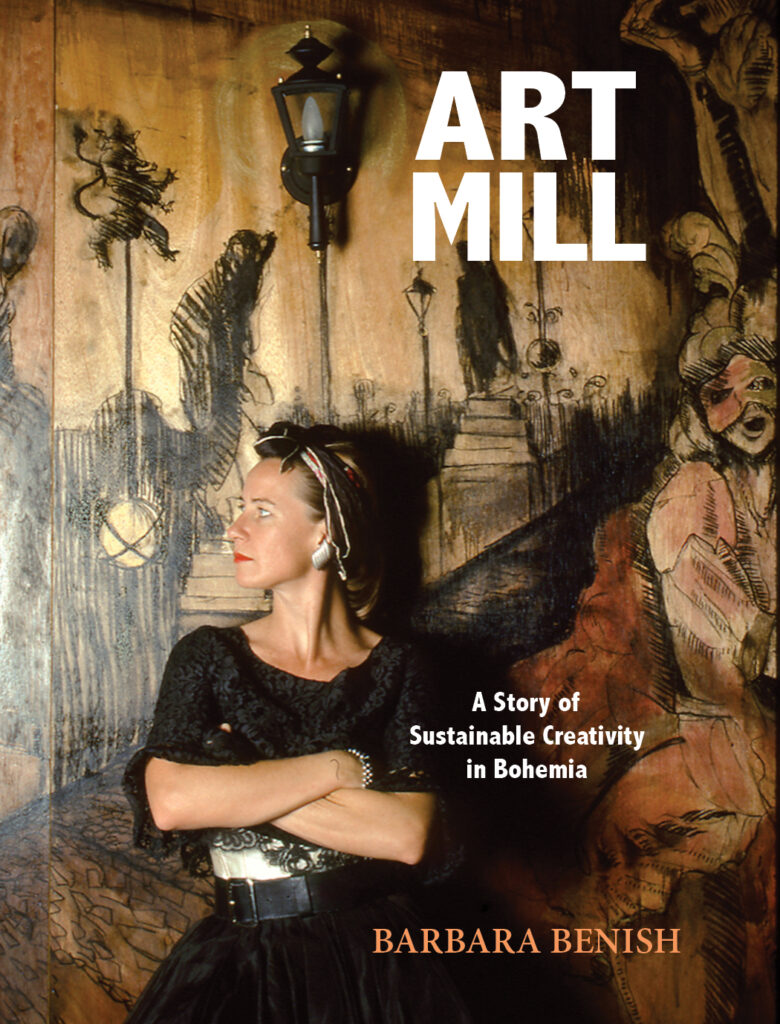
ArtMill
A Story of Sustainable Creativity in Bohemia
by Barbara Benish
The story starts in totalitarian darkness (Czechoslovakia before 1989) and gradually lays out a groundwork for how creativity within community can influence and change society. All of this is rooted in the connection to the natural world, be it local sustainable farming practices, rural innovations, or international policies with governmental bodies on the global level. The book is a success story for a female artist (the author) who found a way to build a life in a rural, posttotalitarian, foreign country, with virtually no income, through her love of the place. It is a testament to the resilience of the people of that small nation that was sacrificed in the tumultuous chess game of colonial superpowers dividing up Europe after the devastation of WWII. It is a textbook protocol on how to instill civil society from the ground up, so that democratic life can thrive. This is a story that has been told in small pieces over the years in essays, catalogues, lectures, and radio and television interviews but needed the deeper context of a fulllength book.
Publisher: New Village Press
Distributor: NYU Press
Publication Date: October 7, 2025
Pages: 252
Images: 60 black & white images
Trim: 10.00 X 7.00 inches
ISBN: 978-1-61332-271-0
Price: $30.00
Primary edition: paperback
Also available in ebook and hardcover

About Barbara Benish
Barbara Benish is a California-born artist and writer inspired by the ocean environment, the Mexican deserts, and surrounding Indigenous cultures. At University of Hawai’i in the early 1980s, Benish’s work in art and ethnology grounded her understanding of the intrinsic connection of environmental protection with social justice, and the relationship of Colonialism, sovereignty and stewardship. The Czechoslovak Revolution in 1989, in which Benish was involved, gave her first-hand experience in social change ignited by the arts.
In 1992 she moved from L.A. to Prague as a Fulbright scholar after co-curating the first cross-cultural exchange between the U.S. and Czechoslovakia in decades. She founded ArtMill in 2004 in rural Bohemia, an international eco-art center.
Benish’s pilgrimage to Bohemia from Southern California to build an artist sanctuary weaves together such a breathlessly entertaining cultural and political history of Czechoslovakia’s transition to democracy that you almost lose sight of the specter of the authoritarian present. But not quite. Fortunately, she lights the path forward for how humans can heal ourselves and our planet through boundless creativity and learning—the result is a masterpiece of scholarship, sensibility and storytelling.
—Sally Jo Fifer, Former President CEO, Independent Television Service; Executive Producer of Independent Lens, PBS
The remarkable story of ArtMill unfolds against the ever-changing background of recent Eastern European history. It begins in the dark days of late Communist Czechoslovakia, proceeds through the exuberant early years of the return of democracy and ends with the contested politics of the region today. Barbara Benish’s absorbing narrative offers a compelling argument for the crucial support that art and artists can provide to society in navigating periods of tumultuous social change.
—Jay A. Levenson, Director, International Program, The Museum of Modern Art